Executive Planning Takeaways
- Peak Operational Window: Mid-October through early March offers optimal climate (20°C–28°C daytime). Midday celebrations between April and June are thermally unviable outdoors.
- Marine Logistics: Lake Pichola island events (e.g., Jagmandir) require separate passenger shuttle rotations and early-morning dedicated freight barges for sound, staging, and floral load-ins.
- Strict Acoustic Curfew: Rule 5 of the Noise Pollution (Regulation and Control) Rules, 2000 mandates a strict 10:00 PM cutoff for outdoor amplified sound, strictly monitored across lake surfaces. Evening transitions indoors must be pre-planned.
- Historic Urban Access: 45-seater coaches cannot navigate 16th-century walled gateways around Lal Ghat and Jagdish Chowk. Transit strategies must rely on 12–17 seater tempo travellers and multi-utility vehicles (MUVs).
- Pricing Transparency: Pricing depends on timings & availability. Actual wedding budgets depend on venue, guest profile, dates, scope and design direction. Any figures shown are planning guidance and should not be treated as a quotation.
Contents of this Guide
- Why Couples Choose Udaipur for a Destination Wedding
- Udaipur’s Wedding Atmosphere and Architectural Character
- Best Time of the Year: Seasonal & Thermal Breakdown
- Udaipur Venue Landscape: Palaces vs. Resorts vs. Boutique Estates
- Lake Pichola & Waterfront Wedding Considerations: Marine Operations
- Guest Accommodation & Room Block Separation
- Guest Transportation & Old City Traffic Realities
- Event Production, Barge Access & Technical Load-In
- Weather Contingency Planning: Monsoon & Winter Winds
- Noise Regulations, 10:00 PM Curfew & Event Pacing
- How Many Days a Udaipur Wedding Requires
- Example 12-Month Udaipur Planning Framework
- Frequently Asked Questions
- Plan Your Udaipur Celebration
1. Why Couples Choose Udaipur for a Destination Wedding
Framed by the ancient Aravalli Range and cradled by an interconnected basin of historic lakes—principally Lake Pichola, Fateh Sagar, and Udai Sagar—Udaipur occupies an established position in the international destination wedding landscape. Yet the decision to host a multi-day celebration in this southern Rajasthan city rarely rests on scenic romance alone. For families and couples evaluating destination feasibility, Udaipur delivers a concentration of heritage infrastructure unmatched in South Asia: centuries-old royal palaces maintained under meticulous private trust and five-star hospitality stewardship, direct air connectivity to major domestic hubs, and a seasoned ecosystem of master artisans, brass bands, and royal hospitality specialists.
Unlike beach destinations that offer modern resort uniformity, an Udaipur wedding integrates living Rajput history into the celebration. The city operates as an experiential theater where ceremonies unfold across marble courtyards, illuminated lake ghats, and terraced gardens originally designed for royal durbars and coronations. However, orchestrating a celebration across these historic environments requires moving beyond aesthetic appreciation into rigorous operational execution.
2. Udaipur’s Wedding Atmosphere and Architectural Character
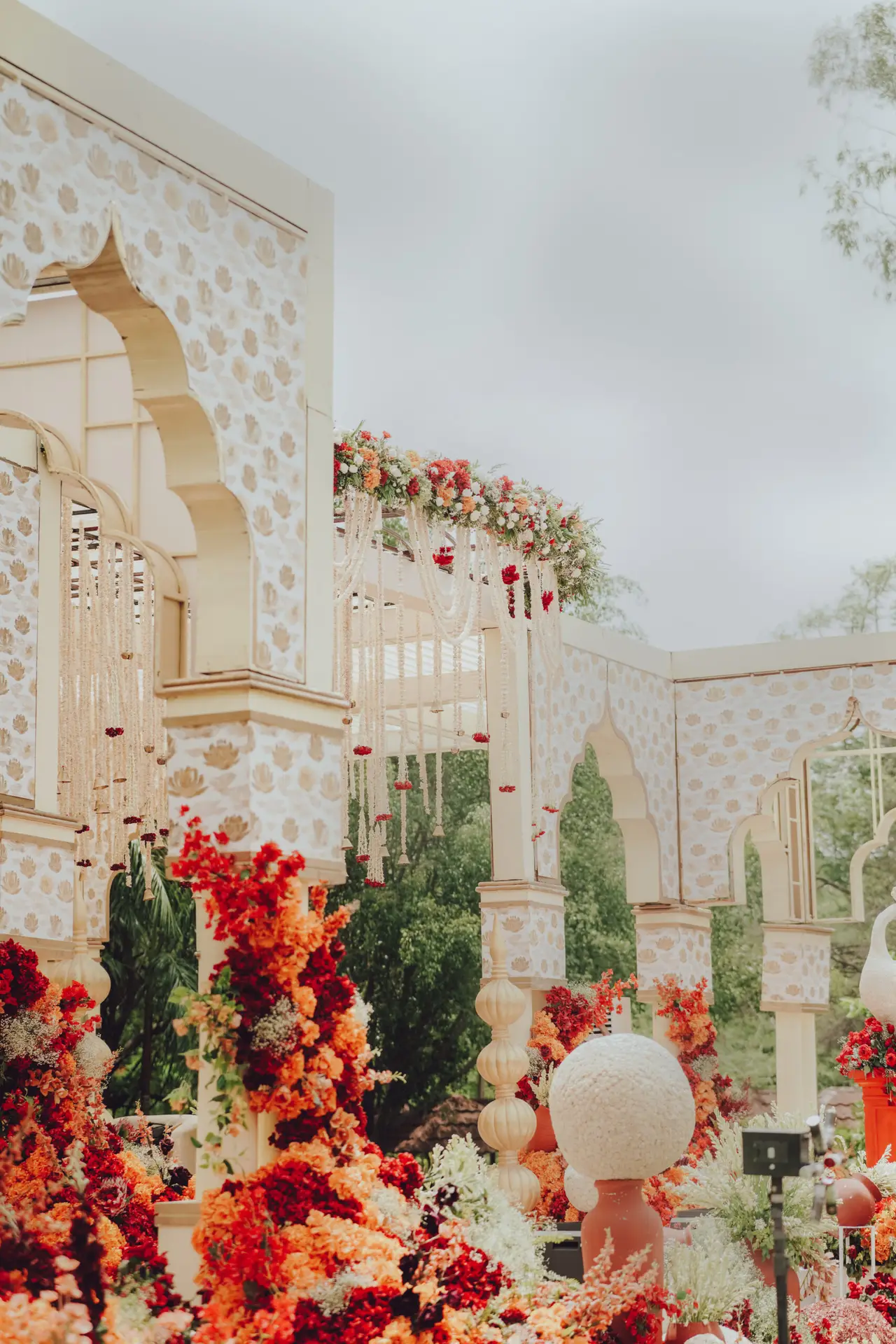
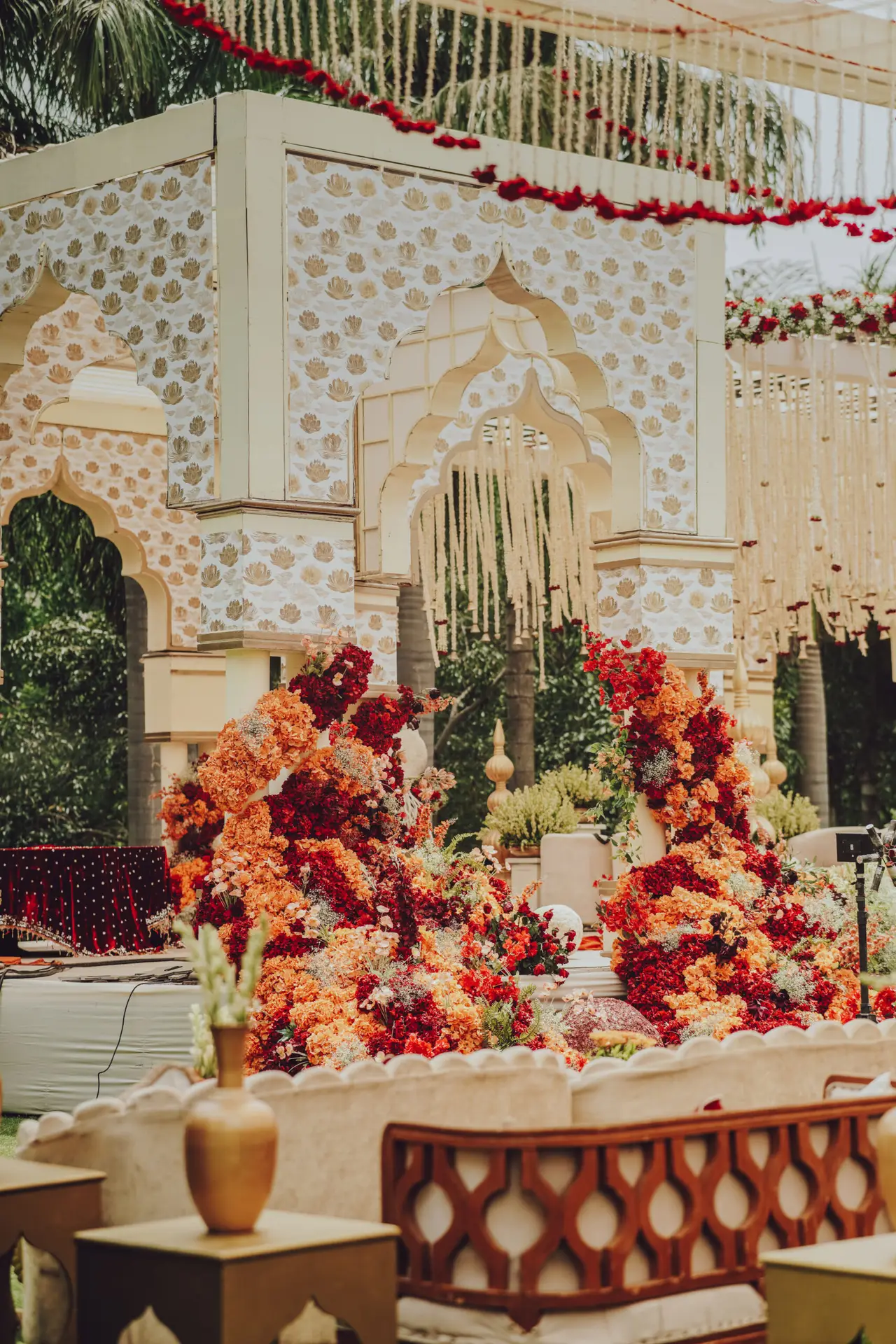
The architectural visual language of Udaipur is defined by Mewari masonry: scalloped arches, cusped jharokhas (overhanging enclosed balconies), chhatris (elevated dome-shaped pavilions), intricately carved white marble, and yellow soapstone. This creates a distinct visual rhythm. By day, sunlight reflects across water bodies onto whitewashed heritage facades; by twilight, the lakeside palaces transform into amber-lit reflections across Lake Pichola.
Because the City Palace complex was constructed across four centuries beginning in 1559 by Maharana Udai Singh II, events hosted within or adjacent to this zone carry an inherent sense of permanence. Décor does not need to manufacture artificial heritage through fiberglass props; instead, floral and lighting design must respect, frame, and accent the authentic stone architecture. A restrained approach—utilizing indigenous tuberoses (rajnigandha), marigolds, local Mogra, brass deepams, and architectural amber washes—frequently produces a far more luxurious atmosphere than heavy, westernized fabric drapes that obscure historic carved stone.
3. Best Time of the Year: Seasonal & Thermal Breakdown
Selecting the wedding calendar in Udaipur requires balancing ambient temperatures, tourist volume, and lake water levels:
| Season Window | Ambient Temperatures | Water Levels | Operational Feasibility & Recommendations |
|---|---|---|---|
| Peak Winter (Nov – Feb) | Day: 20°C – 28°C Night: 8°C – 14°C | Full to Stable | Prime Wedding Window. Perfect outdoor weather for afternoon Mehendi and sunset Pheras. High hotel tariffs, heavy tourist traffic, and tight room inventory require booking 10–14 months in advance [VERIFY]. |
| Shoulder Season (Oct & Mar) | Day: 28°C – 34°C Night: 14°C – 19°C | Post-Monsoon High (Oct) Declining (Mar) | Favorable Balance. October benefits from pristine lake levels and lush Aravalli hillsides. March has warm afternoons, necessitating that ceremonies begin after 4:30 PM. Competitive room pricing. |
| Summer Period (Apr – Jun) | Day: 36°C – 42°C+ Night: 24°C – 28°C | Seasonal Low | Severe Thermal Constraints. Daytime outdoor gatherings are operationally unviable before 5:30 PM. Mandaps require climate-controlled evaporative cooling systems or indoor banquet halls. Lower property buyout rates. |
| Monsoon Months (Jul – Sep) | Day: 28°C – 33°C Night: 22°C – 25°C | Replenishing / High | Dramatic Greenery with Rain Risk. Highly picturesque mist over the hills and overflowing lakes. Outdoor lawn events require German hangar waterproof clear-span structures on full standby. |
4. Udaipur Venue Landscape: Palaces vs. Resorts vs. Boutique Estates
Venue selection in Udaipur dictates every downstream logistical decision, from luggage movement to sound curfews. The city’s luxury venue inventory categorizes into three primary operational models:
A. Island Heritage Palaces (Water-Locked Exclusivity)
Properties such as Jagmandir Island Palace (the 17th-century “Lake Garden Palace”) and Taj Lake Palace (built in 1746 by Maharana Jagat Singh II) represent Udaipur’s most iconic wedding imagery. However, they function under unique physical realities:
- Room Inventory Split: Jagmandir Island Palace is primarily an event destination with very limited suites (historically 7–14 suites [VERIFY]). Consequently, the entire guest room block must reside at mainland partner properties (such as Taj Fateh Prakash Palace or Shiv Niwas Palace), requiring scheduled ferry crossings for every function.
- Spatial Capacity: Jagmandir’s expansive garden courtyards can host 300 to over 800 floating guests for a grand dinner reception, whereas Taj Lake Palace operates under strict guest caps suited for intimate high-luxury gatherings of 80–120 guests [VERIFY].
B. Mainland Shoreline Palaces & 5-Star Luxury Resorts
Mainland estates situated along the western and eastern banks of Lake Pichola combine lake frontage with consolidated accommodation blocks:
- The Oberoi Udaivilas: Features 87 luxury keys, traditional Mewari dome architecture, interconnected reflecting pools, and private lakeside promenades. Best suited for complete property buyouts with guest lists of 150 to 300 [VERIFY].
- The Leela Palace Udaipur: Offers 80 lake-facing rooms and suites, arrival via ceremonial royal boats from a private mainland jetty, and picturesque outer lawns overlooking the City Palace. Ideal for high-refinement gatherings of 120–200 guests [VERIFY].
- Trident Udaipur: Positioned on 43 acres of landscaped grounds near Udaivilas, providing 142 keys [VERIFY], excellent hospitality infrastructure, and lawn capacities suited for high-headcount functions or serving as a primary accommodation hub.
C. Valley Expanses and Modern Palaces (Large Inventory)
For celebrations with 300 to 1,000+ guests seeking to avoid room splitting across multiple hotels, properties located just outside the congested historic basin offer extensive infrastructure:
- Fairmont Udaipur Palace (Sisarma): Positioned in the tranquil valley of Sisarma, featuring 327 rooms and suites, over 100,000 square feet of banqueting and lawn space, and a private helipad [VERIFY]. This allows couples to host 500+ guests under one roof while preserving Mewari palace aesthetics.
- Raffles Udaipur: Situated on a private 21-acre island in Udai Sagar Lake (a 25-minute drive from the airport), offering 101 keys [VERIFY], complete acoustic seclusion, and world-class culinary curation.
- Fateh Garh & Aurika Udaipur: Elevated hilltop properties on the western ridges offering panoramic vistas of the lake basin and city skyline, with room inventories capable of supporting 200–350 guests.
5. Lake Pichola & Waterfront Wedding Considerations: Marine Operations
Executing an event on Lake Pichola requires the discipline of maritime logistics. When hosting a function at Jagmandir Island Palace or arriving at The Leela Palace by water, the movement of human beings and technical cargo must be decoupled completely:
“The single most frequent mistake in lakefront wedding planning is treating boat transfers as a casual amenity rather than a time-tabled transport network. A 250-guest transit over water requires a naval deployment plan.”
Key operational rules for Lake Pichola marine transfers:
- Passenger Craft Capacities: Standard motorized wooden Shikaras accommodate 10 to 14 guests, while larger pontoon barges carry 25 to 30 passengers. To transfer 250 guests from Bansi Ghat jetty to Jagmandir requires a continuous 8-to-12 vessel rotation cycle, requiring 45 to 60 minutes for complete boarding and disembarkation [VERIFY].
- The Baraat on Water: The groom’s ceremonial arrival boat must maintain a designated speed and buffer distance from guest ferries. It requires an independent audio craft equipped with compact line-array speakers and battery-inverter systems or silent marine generators to power live dhol and shehnai players without audio dropouts mid-lake.
- Dedicated Cargo Barges: Production trussing, sound equipment, floral crates, refrigeration units, and catering personnel must never share passenger boats. Cargo movement must commence via flatbed freight barges at 6:00 AM on the morning of the event, well before guest transfers begin.
- Statutory Permits: Vessel licensing, mandatory life-jacket compliance, passenger insurance, and municipal water-police clearances must be filed and confirmed through the Lake Patrol and hotel marine management prior to the wedding week.
6. Guest Accommodation & Room Block Separation
When selecting hotels in Udaipur, guest distribution across the room inventory dictates the daily stress level of the wedding party. Planners must evaluate whether a single hotel buyout is possible or if a split-hotel model is necessary:
- Single-Hotel Buyout Model: The cleanest operational framework. Buying out the entire property (e.g., 80 keys at The Leela Palace or 87 keys at Udaivilas [VERIFY]) ensures complete privacy, personalized branding, no complaints from external hotel guests regarding music or ritual processions, and zero transit friction between bedrooms and function lawns.
- Split-Hotel Satellite Model: When hosting 350+ guests at a heritage venue with limited rooms, guests are distributed across primary (bride/groom family) and secondary (friends, extended relations) hotels. Rule of thumb: All secondary properties must be located within a 15-to-20-minute transit radius of the primary event jetty or banquet gates to prevent scheduling collapse.
7. Guest Transportation & Old City Traffic Realities
Udaipur’s historic core surrounding Lake Pichola was engineered during the medieval era for horses, elephants, and palanquins—not modern automotive fleets. Narrow cobblestone streets, sharp 90-degree corners, and steep gradients mean that standard 45-to-55-seater multi-axle tourist coaches are strictly prohibited and physically unable to navigate past Jagdish Chowk or Hathipole gates.
Operational fleet guidelines for Udaipur:
- Vehicle Fleet Selection: All guest airport transfers and intra-city shuttles within the historic zone must utilize premium Multi-Utility Vehicles (Toyota Innova Crysta / Hycross) or customized 12-to-17-seater luxury urban tempo travellers.
- Staging Zones: Establish designated motor-pool drop points (such as the outer gates of the City Palace or Dudh Talai) where guests transfer seamlessly from vehicles to battery-operated golf carts or jetty boarding docks.
- Driver Route Cards: Every hired driver must be issued laminated route cards with exact navigation paths that explicitly avoid tourist bottlenecks near the Clock Tower and Bada Bazaar during peak afternoon traffic.
8. Event Production, Barge Access & Technical Load-In
Building high-production wedding sets in Udaipur requires structural sensitivity. Heritage palaces are protected historical structures, and hotel managements enforce strict structural preservation rules:
- Zero-Drill Guidelines: Bolting, drilling, nailing, or anchoring into palace stone, marble balustrades, or heritage plaster is universally prohibited. All structural trussing for Mandaps, floral backdrops, and lighting rigs must be self-supporting, balanced with calibrated water or sandbag counterweights.
- Power Redundancy: Historic palace sub-stations frequently have strict amperage limits. High-draw moving lights, beam fixtures, LED video walls, and heavy catering equipment necessitate supplemental silent diesel generator sets (typically twin 125–250 kVA synchronized units) staged in acoustic-baffled service zones [VERIFY].
- Load-In Buffers: For island venues, production load-in requires a minimum 24-hour setup window due to the slow turnaround times of freight barges. Trying to rig a major Sangeet stage on the day of the event on an island venue is a recipe for delay.
9. Weather Contingency Planning: Monsoon & Winter Winds
Even during the coveted winter months, outdoor planning requires environmental foresight:
- Lakeside Thermal Drop & Night Chill: In December and January, ambient temperatures drop sharply after sunset from 24°C to below 10°C. Outdoor banquets on lake promenades become uncomfortably cold without planned radiant outdoor gas patio heaters stationed every 5 meters, live charcoal braziers (angithis) in sheltered lounges, and luxury pashmina or cashmere wraps offered at welcome desks.
- Surface Water Winds: Open lake surfaces experience sudden localized gusts in the late afternoon. Floating floral arrangements and lightweight table centerpiece votives must be secured with heavy floral bases and enclosed hurricane glass sleeves to prevent blown candles and flying linen.
- Monsoon Cover: July–September events must mandate an all-weather clear-span German hangar structure over primary lawns, or retain an indoor banquet hall contractually blocked as a 100% weather backup.
10. Noise Regulations, 10:00 PM Curfew & Event Pacing
Compliance with noise regulations is one of the most critical operational parameters of an Udaipur destination wedding. Under Rule 5 of the Noise Pollution (Regulation and Control) Rules, 2000, the use of outdoor loudspeakers, live amplification, and public address systems is strictly prohibited between 10:00 PM and 6:00 AM [VERIFY].
Because open water carries acoustic vibrations directly across Lake Pichola into municipal and residential zones, the local police administration and marine patrol enforce the 10:00 PM cutoff with zero tolerance. Attempting to bribe or negotiate past 10:00 PM outdoors risks sudden power disconnection, equipment seizure, and public embarrassment.
The Professional Pacing Solution:
- Design outdoor Sangeets and lakeside performances to begin promptly at 7:00 PM, concluding headline artist acts and grand family choreography by 9:45 PM.
- At 10:00 PM sharp, transition the entire wedding party into pre-styled, acoustically isolated indoor ballrooms—such as the Durbar Hall, Mewar Hall, or Fairmont’s The Jewel—where late-night DJ sets, full-volume sound, and open bars can legally continue until 3:00 AM or dawn.
11. How Many Days a Udaipur Wedding Requires
A destination celebration in Udaipur typically spans 3 Nights and 4 Days (or a compressed 2 Nights / 3 Days framework for regional guests). Because guest travel requires domestic flights into Maharana Pratap Airport (UDR) followed by a 40-to-50 minute highway transfer to the city center, Day 1 must serve as a relaxed arrival and welcome evening rather than an intensive ritual day.
For an in-depth breakdown of how to structure ritual timing, prevent guest exhaustion, and balance multi-day events, explore our comprehensive guide: How Many Days Should a Rajasthan Destination Wedding Be?
12. Example 12-Month Udaipur Planning Framework
Planning a high-calibre wedding in Udaipur requires a sequential 12-month milestone timeline:
| Milestone Phase | Timing | Core Operational Deliverables | Responsible Stakeholders |
|---|---|---|---|
| Phase 1: Feasibility & Lock | 12 – 10 Months Out | Establish realistic budget framework; conduct on-site venue recce; lock primary palace buyout dates; finalize hotel contracts and room attrition clauses. | Couple, Family & Wedding Planning Director |
| Phase 2: Creative & Legal | 9 – 7 Months Out | Finalize 7-Phere event flow concept; appoint primary photographers and headliner artists; initiate music licensing filings (PPL/IPRS/Novex via Sangeet Dwar) [VERIFY]; review municipal jetty permissions. | Shaadi Swagat Planning Command & Legal Liaison |
| Phase 3: Technical Design | 6 – 4 Months Out | Approve 3D scenography and zero-drill Mandap structural engineering; calculate electrical load demands; contract supplemental generators; finalize tasting menus and regional Marwari cuisine. | Production Engineer, Décor Team & Executive Chefs |
| Phase 4: Logistics & RSVPs | 3 – 1 Month Out | Build dynamic flight/train arrival matrix; allocate color-coded luggage tags; lock vehicle fleet (MUVs and tempo travellers); confirm boat shuttle rotation manifests with Bansi Ghat authorities. | Swagat Hospitality Lead & Transport Motor Pool |
| Phase 5: Ground Execution | Wedding Week | Establish 24/7 command centre at host hotel; execute 6:00 AM barge cargo load-ins; deploy airport terminal greeting pods; coordinate seamless ritual execution and after-party indoor transitions. | On-Ground Command Centre & Specialized Leads |
13. Frequently Asked Questions
How much does a destination wedding in Udaipur cost?
A destination wedding in Udaipur varies widely based on venue exclusivity, room count, and production scale. An intimate boutique heritage wedding for 100–150 guests typically ranges from ₹40 Lakhs to ₹70 Lakhs [VERIFY]. A 5-star commercial resort celebration for 150–250 guests ranges between ₹80 Lakhs and ₹1.80 Crores [VERIFY]. Luxury palace weddings at recognized heritage properties generally range from ₹1.80 Crores to ₹4 Crores, while full-scale buyouts of iconic royal palaces (such as Udaivilas or Taj Lake Palace) can range from ₹4.50 Crores to ₹10+ Crores [VERIFY]. For a full financial breakdown, see our detailed guide: How Much Does a Destination Wedding in Rajasthan Cost?
Can we play loud music outdoors after 10:00 PM in Udaipur?
No. Under Rule 5 of the Noise Pollution (Regulation and Control) Rules, 2000, outdoor amplified sound is strictly prohibited between 10:00 PM and 6:00 AM across India [VERIFY]. In Udaipur, because sound reverberates across open lake water, local authorities enforce this regulation strictly. All outdoor Sangeets and receptions must stop amplified sound at 10:00 PM, transitioning guests into acoustically treated indoor ballrooms for late-night after-parties.
How do guests travel to island venues like Jagmandir Palace?
Guests board licensed passenger ferries and motorized Shikaras at designated mainland jetties (most commonly Bansi Ghat at the City Palace). A typical transfer involves a fleet of 8 to 12 boats rotating continuously, taking 45 to 60 minutes to transfer a party of 250 guests [VERIFY]. Heavy production cargo, sound gear, and catering supplies must be transported on dedicated freight barges earlier in the day.
Can big 45-seater tourist buses reach Udaipur lakeside hotels?
No. Large 45-seater luxury coaches cannot navigate the narrow historic streets and gates leading to Lake Pichola (such as Lal Ghat and Jagdish Chowk). Guest movement must be handled using smaller luxury vehicles—predominantly 12-to-17-seater tempo travellers and premium multi-utility vehicles (Toyota Innova Crysta / Hycross)—paired with electric golf carts for final pedestrian access.
How far in advance should we book an Udaipur wedding palace?
For prime winter wedding dates (November through February), iconic properties such as The Oberoi Udaivilas, Taj Lake Palace, Jagmandir, and The Leela Palace should be secured 10 to 14 months in advance [VERIFY]. Auspicious wedding dates (Saya dates) see intense competition from both domestic families and international couples.
READY TO PLAN YOUR UDAIPUR CELEBRATION?
Tell us your estimated guest count, preferred dates, and aesthetic vision. Our Udaipur command centre will structure your venue evaluation, marine feasibility, and end-to-end execution roadmap.